You already said it.
Pelican is not the story. You enable the stories to happen. Your CMO said it on camera. It is the most honest brand line in the category, and you have built everything except the films that prove it.
"Pelican is not the story. We enable the stories to happen." — Shawn LaRowe, CMO, on camera
That is a brand brief. Nobody has filled it.
"Built to protect. Protecting all that you value." The instinct is already correct. Case Chronicles with Chris Burkard, the TRVL launch, the prosumer pivot — this is a 50-year brand reaching for story. The reach is right. The format is wrong. Every move so far is a campaign, a submission box, or a spec line. None of it is a film.
A film is the one thing the line is asking for, and the one thing the brand has never shipped.
What you already do well is the reason this works.
A film needs real material. You have more of it than almost any brand alive, and most of it is true.
1976, Torrance, the lifetime guarantee.
Made in the USA, hand-assembled, sub-1% returns. Credibility that is earned, not claimed. The kind a documentary can stand on without flinching.
Engineers wrote the copy. It shows.
Armor construction, freezer-grade seals, Hinomoto wheels. The product writing respects the reader's intelligence. That same respect, pointed at a person, is a film.
Tomato red, black, a flame.
Industrial, legible, unfussy. The identity does not need fixing. It needs a subject worth pointing it at.
You already know there's a gap.
Case Chronicles, Burkard, the prosumer turn. You are reaching for story on your own. We are the part of the reach you can't do with a submission form.
Your best stories are 100 words long. They should be eight minutes.
Seven places the human story is sitting in plain sight, formatted as anything except a film.
Your most committed audience has never been on screen.
You market to cinematographers and DPs as a primary segment. The 1510 is in every working camera kit on earth. You have never made a single film about one of them.
Now: a product page. Could be: a portrait film at film length.Case Chronicles is a form where it should be a film.
The community submits case stories in text, you select one a month, Burkard presents it on social. Right brief. Wrong format. The strongest of those submissions are short documentaries.
Now: a submission box. Could be: a screen.Survival Stories live as 100-word text blocks.
The soldier with C-4 and six satellite phones. The checkpoint case with the images that mattered. The wildfire paramedic. The most cinematic things the brand owns, buried in a scrolling list of paragraphs.
Now: a testimonial wall. Could be: a documentary with editorial distribution.The lifetime guarantee has no human face.
Send in a 25-year-old cracked case, get a new one. The most famous promise in the category, and nobody has filmed the person who sent the case in, or the tech who can date a case by its foam.
Now: a policy line. Could be: a portrait about meaning what you say."Made in USA" is a spec, not a film.
The mold, the polymer, the O-ring, the hands in Torrance. This connects the guarantee to a real place and a real workforce. Right now it's three words on a product page.
Now: three words. Could be: a six-minute observational factory film for investors and procurement.Trade-show content undersells a premium product.
SHOT Show, AUSA, NAB, B&H. You show up multiple times a year and the footage is a handheld booth walkthrough. A premium product documented like a hardware-store flyer.
Now: a booth walkthrough. Could be: a real production pipeline.The prosumer pivot has no flagship film to anchor it.
TRVL, Dayventure, the Burkard partnership, the expedition turn. A $728M brand reinventing itself around adventure and creators, with launches and Instagram and no single authored film that says what the brand now stands for.
Now: announced. Could be: shown.The most-watched thing you own is 18 years old. It's a truck running over a case.
You know exactly how to demonstrate a product. The 2008 torture test still outperforms most of what you've shipped since. You have never learned how to film a person. That single fact is the entire argument for why this is worth doing, and worth doing with a director.
See what a person-film looks like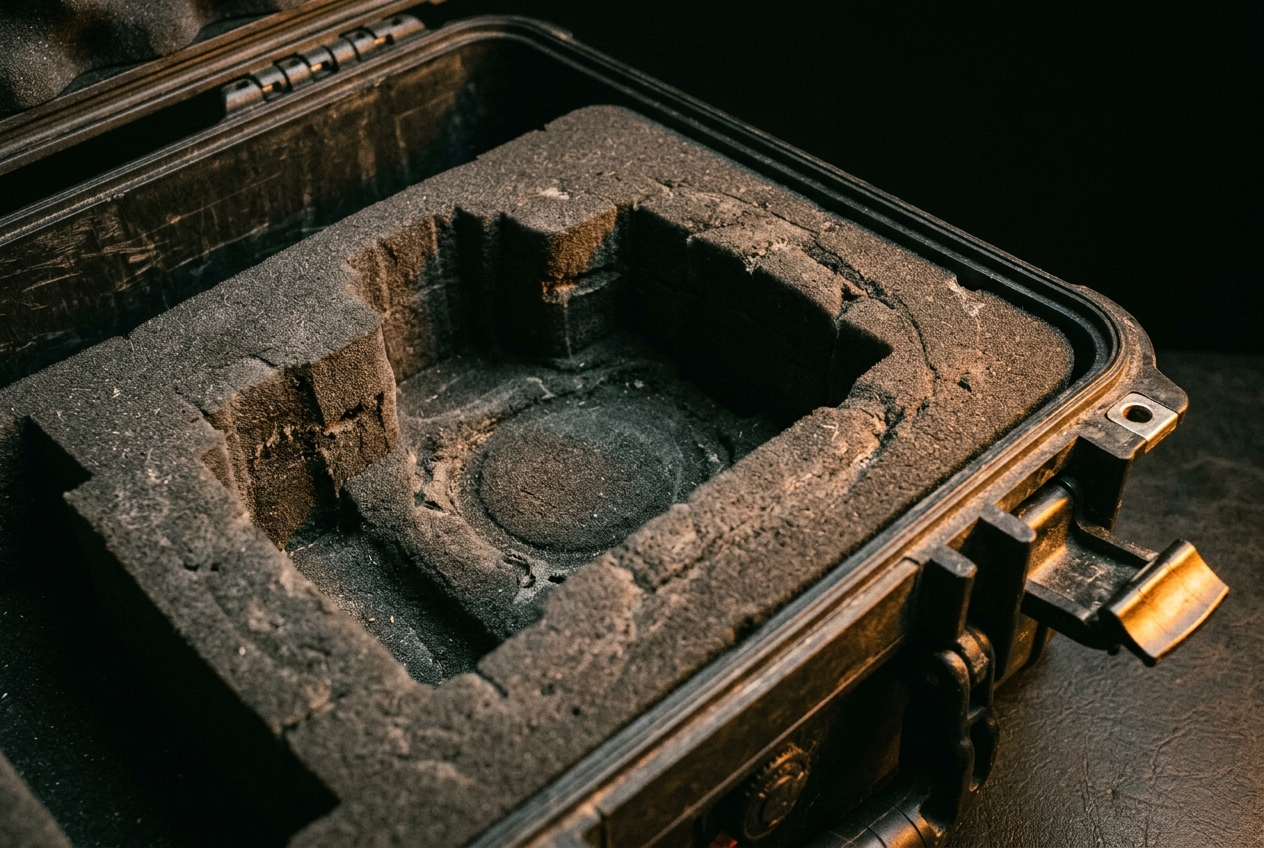
The foam remembers the camera. The brand has never filmed the person who packed it.
The line is written. The film is the proof.
You said you enable the stories. Here is what it looks like when somebody makes one.